Fighting Fraudsters in the Digital Era: Why Credit Analysts Need AI to Analyze Bank Statements
Fraudsters now edit bank statements so precisely that manual review alone can miss the manipulation. This article explains how Fineksi's AI-powered Document Intelligence detects metadata and pixel-level tampering and flags abnormal transaction patterns instantly, without fatigue. Learn how pairing Fineksi as the first line of defense with credit analysts' judgment speeds up lending and lowers NPL risk.
Are You 100% Sure the Bank Statement on Your Desk Is Real?
Technology is moving at lightning speed, and so are fraudsters. Today's fraudsters are no longer amateurs. They are tech-savvy, constantly updating their methods, and using sophisticated tools to manipulate financial documents with remarkable precision, including:
- Balance modification — inflating or adjusting account balances to meet loan requirements.
- Font manipulation down to the pixel level — edits that look identical to the original bank's typography.
- Fabricated transaction histories — fake income, transfers, and spending patterns engineered to look completely natural. These edits are so precise that manual review alone can miss them. For banks, multifinance companies, and other lenders, this creates a serious problem: a document that looks authentic is no longer proof that it is authentic.
Why Manual Review Is No Longer Enough
Financial institutions have long relied on the sharp eyes and intuition of their Credit Analysts (CAs). Their experience and expertise are not in question. But let's be realistic: no matter how skilled an analyst is, they are still human.
When a credit analyst reviews hundreds of pages of bank statements every day, fatigue risk is unavoidable. Attention drops, small inconsistencies slip through, and repetitive checks become routine. These small gaps are exactly what fraudsters exploit to get past human review.
That is why involving Artificial Intelligence (AI) in bank statement analysis is no longer an optional innovation. It is an urgent necessity, and it is exactly what Fineksi, an AI-powered Document Intelligence platform for credit analysis, was built to deliver.
How Fineksi Uses AI to Strengthen Bank Statement Analysis
Integrating Fineksi into credit underwriting and risk management provides layered protection that manual processes simply cannot achieve. Fineksi ingests all of a borrower's documents, including bank statements, and analyzes them in four key ways.
1. Seeing the Invisible: Metadata and Pixel-Level Detection
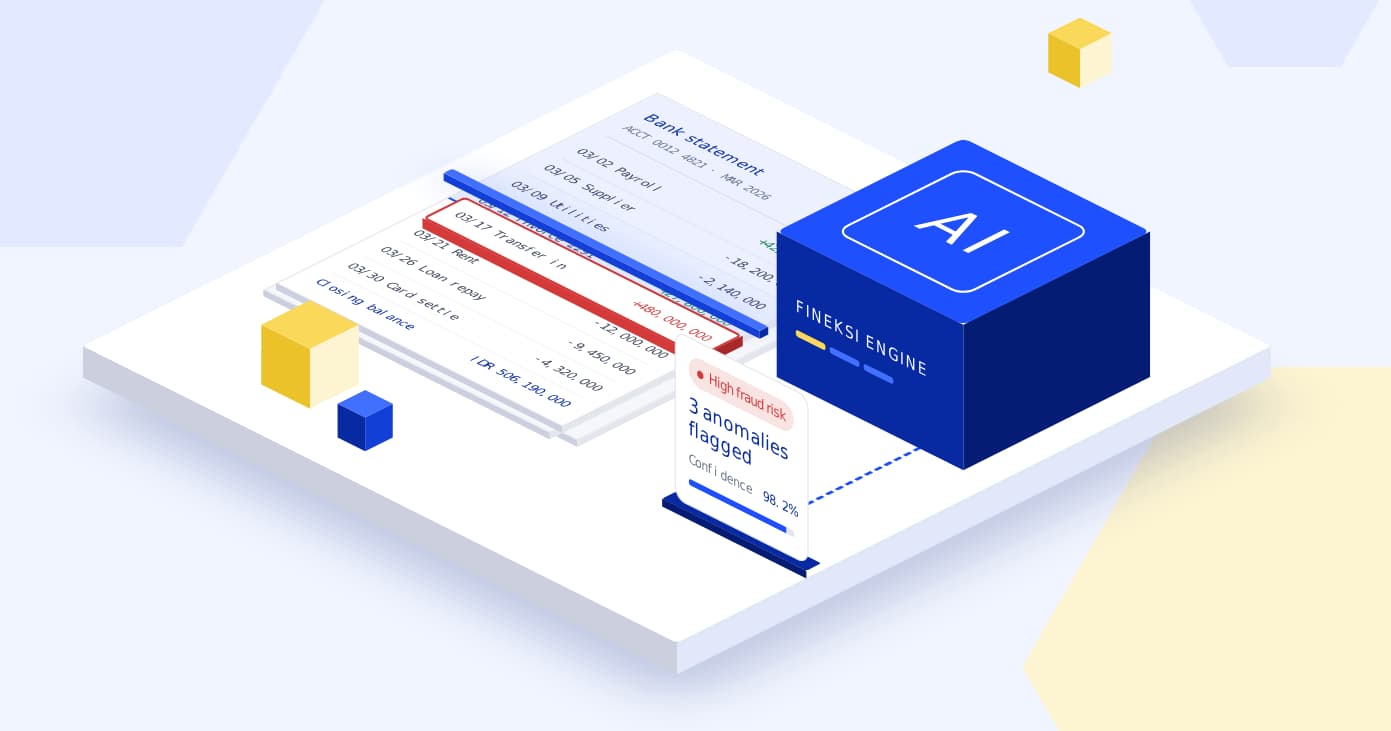
Many forgeries leave no visible trace on the page, but they do leave digital fingerprints. Fineksi analyzes a document's metadata (such as creation and modification history, or the software used to produce the file) and inspects it at the pixel level to find inconsistencies in fonts, spacing, alignment, and image layers. This is tampering that is invisible to the human eye, especially when reviewing documents at volume.
2. Instant Detection of Abnormal Transaction Patterns (Anomaly Detection)
A fabricated statement may look clean line by line, but the overall pattern often doesn't add up. Fineksi's anomaly detection instantly flags irregularities such as:
- Running balances that don't reconcile with recorded transactions
- Unusual round-number deposits or suspicious income spikes before an application
- Circular transfers or "window dressing" activity designed to inflate cash flow
- Transaction behavior inconsistent with the borrower's stated business or profile What could take an analyst hours to cross-check, Fineksi surfaces in seconds.
3. Unlimited Consistency: No Fatigue, Same Standard Every Time
Fineksi applies the same level of scrutiny to the first page of the day and the five-hundredth. It doesn't get tired, distracted, or rushed by end-of-month targets. This consistency removes human fatigue risk from the screening stage and ensures every application is checked against the same standard.
4. Time Efficiency and Scalability
As loan volumes grow, manual review becomes a bottleneck. Fineksi processes large volumes of documents quickly, allowing lenders to approve loans faster without sacrificing quality. Institutions can scale their lending operations without having to scale headcount at the same rate.
Manual Review vs. Fineksi-Assisted Review at a Glance
| Aspect | Manual Review Only | With Fineksi |
|---|---|---|
| Pixel and metadata tampering | Hard to detect | Detected automatically |
| Transaction anomaly checks | Slow, sample-based | Instant, covers every transaction |
| Consistency | Varies with fatigue and workload | Consistent across all documents |
| Processing speed | Hours per application | Minutes per application |
| Scalability | Requires more analysts | Scales with volume |
| Analyst focus | Administrative checking | Investigation and decision-making |
Not Replacing, but Empowering: The Augmented Analyst
Using Fineksi in risk analysis does not mean replacing people with machines. Quite the opposite: it is about empowerment.
Fineksi as the First Line of Defense
Fineksi acts as the first line of defense. It performs technical screening, cleans and structures borrower data, and raises alerts or red flags whenever it finds signs of potential fraud.
Credit Analysts as the Final Decision-Makers
Once Fineksi has filtered out the potential risks, this is where the credit analyst's core skills shine. Freed from tedious administrative work, analysts can redirect their energy toward:
- Conducting in-depth investigations of flagged applications
- Applying business intuition and contextual understanding of the borrower
- Making critical, strategic credit decisions This model is often called the augmented analyst: a credit professional whose judgment is amplified, not replaced, by technology. Combining Fineksi's efficiency with human judgment creates a risk mitigation system with almost no gaps, one that speeds up lending and lowers NPL risk.
Stay Ahead of Fraudsters with Fineksi
Fineksi helps financial institutions streamline their credit process and detect fraud by ingesting all of a borrower's documents and delivering AI-based credit analysis. With Fineksi, lenders can:
- Detect document fraud before it reaches the approval stage
- Analyze bank statements automatically and surface red flags for analysts
- Process loans faster without sacrificing credit quality
- Reduce non-performing loans (NPLs) by catching risky applications early In the digital era, the question is no longer whether fraudsters will use technology. They already do. The real question is whether your credit team is equipped to fight back.
Ready to empower your credit analysts with AI? Contact Fineksi to see how Document Intelligence can protect your lending process.
- Tags
- fraud
- credit analysis
- bank statement
Frequently asked questions
How do fraudsters manipulate bank statements?
Fraudsters use editing tools to change account balances, alter fonts down to the pixel level, and fabricate transaction histories that look natural. These edits are often precise enough that manual review alone can miss them.
Why can't credit analysts detect all bank statement fraud manually?
Credit analysts often review hundreds of pages a day, which leads to fatigue and missed details. Many forgeries also leave traces only in file metadata or pixel-level inconsistencies, which the human eye cannot reliably detect.
How does Fineksi detect fraud in bank statements?
Fineksi analyzes document metadata, inspects files at the pixel level for signs of editing, and runs anomaly detection on transaction patterns. It flags issues such as balances that don't reconcile, suspicious deposits, and activity inconsistent with the borrower's profile.
Will Fineksi replace credit analysts?
No. Fineksi acts as the first line of defense by screening documents and raising red flags. Credit analysts remain the final decision-makers, responsible for investigation, business judgment, and the credit decision.
What is an augmented analyst?
An augmented analyst is a credit professional who uses AI tools like Fineksi to handle repetitive screening and data checks. This frees the analyst to focus on deeper investigation and strategic decisions, combining machine efficiency with human judgment.
How does Fineksi help reduce non-performing loans?
By catching manipulated documents and risky transaction patterns before approval, Fineksi helps lenders avoid extending credit to fraudulent or high-risk borrowers. This improves portfolio quality and lowers NPL risk.
What does Fineksi do?
Fineksi is an AI-powered Document Intelligence platform for credit analysis. It ingests borrower documents, detects fraud, and provides AI-based credit analysis so financial institutions can process loans faster without sacrificing quality.
Cite this article: Fineksi Admin (2026). Fighting Fraudsters in the Digital Era: Why Credit Analysts Need AI to Analyze Bank Statements. Fineksi Blog. https://blog.fineksi.com/en/blog/fighting-fraudsters-in-the-digital-era-why-credit-analysts-need-ai-to-analyze-bank-statements